
Quick answer: in Orange and Osceola County, almost anything that touches structure, electrical, plumbing, mechanical or gas needs a permit — and that covers most kitchens, bathrooms, pergolas, concrete slabs, panel changes, mini splits and garage conversions. Painting, flooring and swapping cabinets in the same spot usually do not. Florida’s new $7,500 exemption sounds like it changes this. For most of these jobs, it does not.
Below is the job-by-job answer for Central Florida, then the detail behind each one.
Does my job need a permit? Job-by-job table
| Job | Permit? | Which permits |
|---|---|---|
| Kitchen remodel (new layout, moved sink or circuits) | Yes | Building + plumbing + electrical, mechanical if ducts move |
| Kitchen: new cabinets and countertops, same layout | No | Exempt in Orange County |
| Bathroom remodel (moving fixtures, new shower pan, new circuits) | Yes | Building + plumbing + electrical |
| Bathroom: new vanity in the same place, retile, paint | Usually no | Cosmetic |
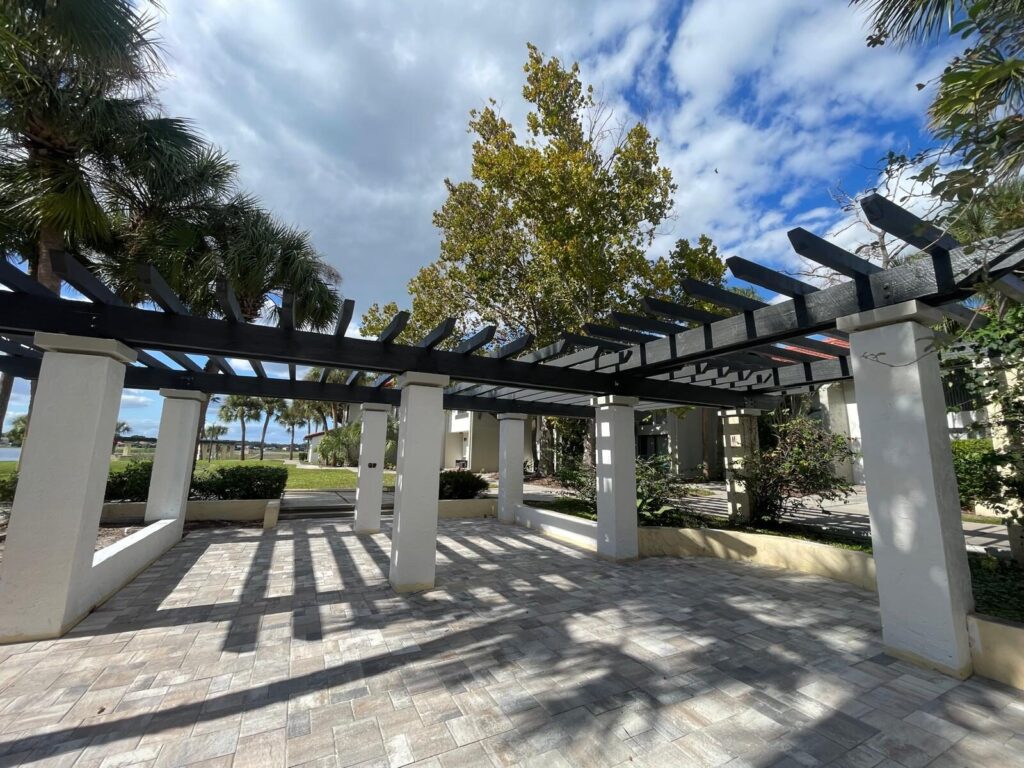
| Pergola or patio cover | Yes | Building, engineered and sealed |
| Concrete slab, driveway, walkway, patio pad | Yes | Permit required when pouring concrete |
| Pavers instead of poured concrete | Zoning only | Orange County treats pavers differently |
| Electrical panel change or service upgrade | Yes | Electrical |
| Adding or moving an outlet | Yes | Electrical |
| Mini split or any permanently installed AC | Yes | Mechanical, plus electrical if wire size or breakers change |
| Portable plug-in AC or heater | No | Exempt |
| Garage conversion to living space | Yes | Building + electrical + mechanical, plumbing if a bath is added; zoning review |
| Screen enclosure, lanai, pool cage | Yes | Building, engineered and sealed |
| Florida room / sunroom (conditioned) | Yes | Building + electrical + mechanical |
| Re-roof or roof-over | Yes | Roofing, with inspections |
| Exterior windows, exterior doors, garage doors | Yes | Building |
| Water heater replacement | Yes | Plumbing, possibly electrical |
| Shed or accessory structure | Yes | Building, even for small ones |
| Fence 6 ft or under | Zoning | Building permit if over 6 ft or masonry |
| Pool | Yes | Building + electrical + plumbing + gas if applicable |
| Interior or exterior painting | No | Exempt |
| Replacing flooring | No | Exempt |
| Landscaping (not irrigation) | No | Exempt; underground irrigation does need a permit |
Rules differ by jurisdiction. Orange County, Osceola County, Orlando city limits, Winter Park, Maitland and Oviedo each run their own review, so we confirm the requirements for your actual address before design starts.
The new $7,500 exemption, and why it rarely helps
Florida’s HB 803 took effect on July 1, 2026. It requires local governments to exempt the owner of a single-family home, or the owner’s contractor, from the building permit requirement for work on that property valued at less than $7,500.
That headline has caused a lot of confusion, so here is the part that matters. The exemption does not apply to:
- Electrical work
- Plumbing work
- Structural work
- Mechanical work
- Gas work
- Any property partly or entirely in a flood hazard area as defined by the Florida Building Code
Read that list against a real kitchen or bathroom and the exemption disappears. A kitchen with a relocated sink is plumbing. A bathroom with a new circuit for the vanity is electrical. A mini split is mechanical and usually electrical too. A pergola is structural. What is actually left is cosmetic work: painting, flooring, cabinetry, drywall finishing.
Two more conditions people miss. The exemption is not automatic — it requires a written request for exemption, and in the City of Orlando you submit a form and wait for review, with the city targeting five business days; the project is considered exempt only after that request goes in. And you cannot split a project into smaller pieces to get under the threshold.
Kitchen remodel
Orange County specifically exempts replacing cabinets or countertops in the same location, without changing the layout. The moment the layout changes, you are permitting the job — and changing the layout is usually the entire point.
Anything that moves the sink, adds small appliance circuits, relocates the range, changes the hood, or takes out a wall is a permitted alteration. Orange County defines an alteration as any construction, retrofit or renovation to an existing structure other than a repair or an addition.
If a wall is coming out as part of it, read what load-bearing wall removal actually involves — that adds sealed engineering to the package. See also our kitchen renovation work and what a kitchen remodel costs in Orlando.
Bathroom remodel
Same logic. A new vanity in the same footprint, new tile and paint is cosmetic. Moving the toilet, relocating the shower drain, converting a tub to a curbless shower, adding an exhaust fan circuit or opening a wall is a permitted alteration with plumbing and electrical sub-permits.
Bathrooms carry a detail kitchens do not: shower pans and waterproofing get inspected. That is the one place where an unpermitted job tends to surface later as a leak inside a wall. More on bathroom renovation and what adding a bathroom costs in Florida.
Concrete slab, driveway or patio
In Orange County, pouring concrete requires a permit — driveways, walkways and concrete pads all count. Pavers are treated differently and need a zoning permit only.
Two things get checked that homeowners rarely think about: how much of your lot is covered by impervious surface, and where the water goes once it cannot soak in. A slab that pushes runoff toward a neighbor or toward your own foundation is the kind of thing plan review exists to catch. See our concrete services.
Pergola or patio cover
Yes, and the plans are engineered. A pergola is a small structure with a very large sail area, so it is designed and sealed for the design wind speed at your specific address, with the posts, anchors and footings specified.
Two non-code items kill more pergola plans than engineering does: setbacks from property lines and easements, and your HOA, whose approval is separate from the county permit and often slower. More in custom pergolas and what a pergola costs and what the permit involves.
Electrical panel change or service upgrade
Yes. Orange County requires an electrical permit for a panel change or a service upgrade, and also for a new or relocated outlet. The utility is involved too, because a service upgrade means a disconnect and reconnect.
This is one where the permit is genuinely protecting you. A panel is the single point where a mistake burns a house down, and the inspection is the only independent check that the work was done right. As a general contractor we pull the permit and coordinate a licensed electrical contractor for the work itself.
Mini split and HVAC
Yes. Orange County requires a mechanical permit for permanently installed air conditioning equipment, and HVAC replacement or modification always requires one. If the new equipment needs a different wire size or breaker, you need an electrical permit as well. Only plug-in portable units are exempt.
The alteration package for HVAC is more involved than most people expect: energy calculations, ACCA Manual J, S and D, an Energy Performance Level display card, and a mechanical duct layout when ductwork is installed or modified. That is also why a properly sized system is not a guess. See mini split installation.
Converting a garage into living space
Yes, and this is the most involved job on the list, because it is a change of use: an unconditioned garage becomes habitable space, and habitable space is held to the standard of the rest of the house.
That means the permit package shows existing and proposed floor plans with every room’s use labeled, and identifies existing and proposed egress from any adjacent sleeping room, marked on the plan. It means insulation and the energy code, electrical for a room rather than a garage, heating and cooling that your existing system may not be sized to carry, and plumbing if a bathroom or laundry is part of it. The floor usually has to come up to level, and the garage door opening has to be framed and finished as a wall.
There is also a zoning question that has nothing to do with the building code: some jurisdictions and most HOAs require a minimum amount of covered or off-street parking, and removing a garage can put you below it. We confirm that for your actual address before design. See garage conversions and ADU construction.
Screen enclosures, Florida rooms and roofs
Screen enclosures and pool cages are engineered structures and are permitted as such. A Florida room — conditioned, insulated, counted as living area — is a bigger permit than a screen room, because it has to meet the code for habitable space, including the load on your air conditioning. Details in patio enclosures and screen rooms.
Roofing: re-roofs require a permit with an in-progress inspection and a final, and roof-overs require a permit and a final inspection. Exterior windows, exterior doors and garage doors all require a building permit, and in Florida they also need a product approval that matches your wind zone.
What Orange County does not require a permit for
- Interior or exterior residential painting
- Replacing flooring
- Replacing cabinets or countertops in the same location, without changing the layout
- Portable plug-in heating or cooling units, and appliances that plug into an existing outlet
- Residential landscaping — but not irrigation systems
- A residential satellite dish
- A residential flagpole up to 15 feet, or a removable sectional flagpole up to 20 feet
Everything else should be assumed to need one until the building department says otherwise.
Osceola County and St. Cloud
Two differences worth knowing if your project is in Osceola County:
- A Notice of Commencement is required for projects valued at $5,000 or more, including labor and materials.
- Renovating or demolishing a structure that contains asbestos requires a permit and an Asbestos Disclosure Statement — which comes up more often than people expect in homes built before the 1980s.
Owner-builder permits, and why we do not recommend them
Florida Statute 489.103(7) lets a property owner act as their own contractor on a one- or two-family home for personal use. It comes with real conditions: you must personally supervise any work not done by licensed contractors, you must still use licensed subcontractors for electrical, plumbing, mechanical and roofing, and you cannot sell or lease the property for one year after completion. In Osceola County the signed owner-builder affidavit has to be submitted in person with the application.
The red flag to watch for: a contractor who asks you to pull an owner-builder permit for work they are doing. That is not a shortcut, it is a liability transfer. It puts the code responsibility, the inspection failures and the warranty on you, and it usually means they cannot pull the permit themselves.
A licensed contractor accepts the permit under their own license. ALFE pulls permits under our General Contractor license, CGC1536320, and coordinates every inspection to the final.
What if work was already done without a permit
We see this constantly, usually discovered at the worst moment: a buyer’s inspector asks why there is a beam with no permit history, or an insurance carrier asks for documentation after a claim. Unpermitted work follows the house, not the person who did it.
It is fixable. We assess what was done, bring in the engineer where structure is involved, and work with the jurisdiction on a retroactive permit. It costs more than doing it right the first time, largely because closed-up work usually has to be opened back up for inspection — but it is far cheaper than finding out at the closing table.
How ALFE handles it
Federico is a civil engineer and the licensed qualifier for the company, so the drawings, the calculations and the submittal happen in house rather than between three vendors. We confirm the rules for your actual address first, assemble the package, pull the permits under our license, and manage the inspection sequence through to the final.
ALFE Contracting Services works out of St. Cloud and serves Orlando, Lake Nona, Winter Park, Oviedo, Windermere, Dr. Phillips, Winter Garden, Horizon West, Baldwin Park, Maitland, Lake Mary, Kissimmee and Clermont. More on permitting and design services.
Free assessment: (321) 732-5615
Frequently Asked Questions
Do I need a permit to remodel a kitchen in Florida?
Yes, if the layout changes or if plumbing, electrical or mechanical is moved. Orange County exempts replacing cabinets or countertops in the same location without changing the layout; everything beyond that is a permitted alteration. The new $7,500 state exemption does not help here, because it excludes plumbing and electrical work.
Do I need a permit to remodel a bathroom?
If you are moving the toilet, relocating a shower drain, converting a tub to a shower, adding a circuit or opening a wall, yes — building plus plumbing and electrical sub-permits. A new vanity in the same footprint with new tile and paint is normally cosmetic and does not need one.
Do I need a permit for a pergola in Central Florida?
Yes. A pergola is a structure, and the plans are engineered and sealed for the design wind speed at your address, including posts, anchors and footings. Setbacks from property lines and HOA approval are separate from the county permit and should be checked before design starts.
Do I need a permit to pour a concrete slab or driveway?
Yes. In Orange County a permit is required when pouring concrete, including driveways, walkways and concrete pads. Pavers are treated differently and need a zoning permit only. Impervious area and drainage are both reviewed.
Do I need a permit to change my electrical panel?
Yes. Orange County requires an electrical permit for a panel change or a service upgrade, and also for adding or relocating an outlet. The $7,500 exemption specifically excludes electrical work. As a general contractor we pull the permit and coordinate a licensed electrical contractor.
Do I need a permit to install a mini split?
Yes. A mechanical permit is required for permanently installed air conditioning equipment, and an electrical permit as well if the wire size or breaker changes. Only plug-in portable units are exempt. The package includes energy calculations and ACCA Manual J, S and D.
Do I need a permit to convert my garage into a room?
Yes. It is a change of use from unconditioned to habitable space, so it is held to the same code as the rest of the house: insulation and energy code, egress from adjacent sleeping rooms marked on the plans, electrical, heating and cooling, and plumbing if a bathroom is added. There is also a zoning and HOA question about minimum parking that has to be confirmed for your address.
Does the new $7,500 Florida permit exemption cover my remodel?
Usually not. HB 803 took effect July 1, 2026 and exempts single-family work valued under $7,500, but it excludes electrical, plumbing, structural, mechanical and gas work, and any property in a flood hazard area. It also requires a written exemption request and cannot be obtained by splitting a project into smaller pieces. In practice it covers cosmetic work.
What happens if I remodel without a permit?
Beyond fines and a stop-work order, the work follows the house. It surfaces when you sell and the buyer’s inspector finds it, or when an insurance carrier asks for documentation after a claim. Retroactive permitting is possible but usually means opening closed-up work back up for inspection.
Can my contractor ask me to pull the permit?
They can ask, and you should treat it as a warning. An owner-builder permit puts the code responsibility, the failed inspections and the warranty on you, and a contractor who cannot pull a permit under their own license is telling you something important. A licensed contractor accepts the permit themselves.